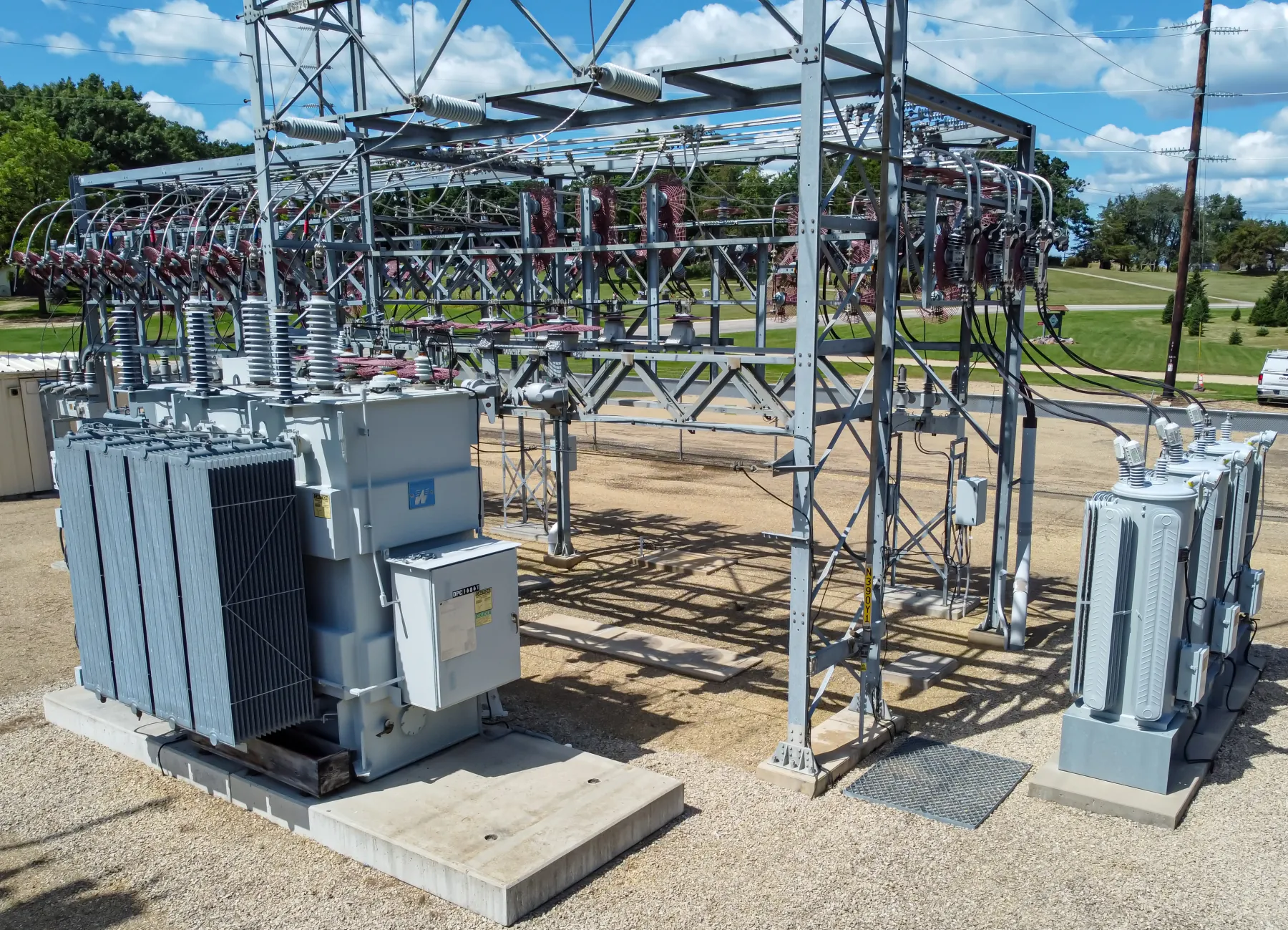
The electric future arrives in public as a procession of finished objects: a data center, a battery plant, a row of chargers, a new subdivision. Behind nearly every one sits a less photogenic machine that determines whether it can turn on.
A transformer does not generate electricity. It changes its voltage. That simple operation is what allows power to move efficiently across a continent and then arrive at a level a building can use. Large units connect power plants and transmission networks. Smaller distribution transformers—the gray cylinders on poles and the locked green boxes beside sidewalks—make the final conversion for homes and businesses.
They are among the oldest technologies in the modern grid, and among the clearest demonstrations that demand for the future can collide with the production system of the past.
The United States has an estimated 60 million to 80 million distribution transformers in service. The National Renewable Energy Laboratory estimates that roughly 55 percent are more than 33 years old.1 At the same time, utilities are connecting new factories, electric vehicles, heat pumps, solar arrays and an exceptional wave of data-center load. Replacement demand and growth demand are arriving together.
The result is not simply a shortage of metal boxes. It is a shortage of factories, electrical steel, trained labor, common specifications, testing capacity, capital and time.
The factory hidden inside the grid
A distribution transformer appears standardized because its job is standardized. Inside, however, utility requirements can vary across voltage, capacity, mounting, protection, connectors, fluids, noise limits and environmental conditions. The Department of Energy has identified more than 80,000 varieties used across the country.3
Variation has legitimate roots. Utilities inherited different networks, climates and operating practices. Equipment expected to survive coastal salt, mountain ice or desert heat should not be identical in every detail. But accumulated preference can harden into specification debt. A bracket moved for one crew, an accessory retained from an old fleet and a test procedure written around an incumbent supplier each seem harmless. Across thousands of buyers, they turn a nominally common product into high-mix manufacturing.
That matters because transformers are physical systems with unforgiving tolerances. A manufacturer must cut and stack magnetic core material, wind conductors, insulate assemblies, dry them, place them in a tank, add cooling and protection equipment, fill liquid units, and test the finished machine. Large power transformers can be custom projects measured in hundreds of tons. Even distribution units are not interchangeable commodities in the way their silhouettes suggest.
In 2019, typical distribution-transformer lead times were measured in three to six months. By 2024 they had risen to one or two years, sometimes longer; large units could require three to four years.2 That delay changes the economics of everything downstream. A completed building waiting on one transformer is inventory. A utility that cannot replace a failed unit carries more operational risk. A developer expecting just-in-time electrical equipment learns that the grid has its own calendar.
Demand is not one number
“Electrification” is often discussed as a smooth curve. Transformer demand is lumpy.
A subdivision may need dozens of small units. A hyperscale campus can require a sequence of large substations and many medium-voltage transformers. A hurricane can destroy a concentrated inventory in hours. Solar and wind projects need transformers too, often stepping voltage up rather than down. Aging changes the curve again: an old unit under higher load runs hotter, and heat accelerates the deterioration of its insulation.
This makes forecasting difficult. Utilities place orders against uncertain local projects, manufacturers invest against aggregated demand they may not see, and customers reserve equipment early because lead times are long. That reservation behavior can inflate order books without making the underlying need fictitious. It is rational competition for a slow resource.
NREL’s national work suggests annual capacity requirements will grow faster than the number of units because new loads are larger and utilities will need to upsize parts of the installed base.1 The industrial question is therefore not merely how many cans can be shipped. It is whether production can move toward larger, more capable units without abandoning the replacements the existing grid requires.
The material bottleneck inside the machine
The core of a conventional transformer is built from electrical steel engineered to channel magnetic flux while limiting losses. Copper or aluminum conductors carry current through its windings. Insulation has to survive decades of thermal and electrical stress. Each material participates in a separate global supply chain.
Electrical steel is particularly revealing. The best material for a transformer is not ordinary sheet steel. It needs controlled composition, grain structure and coating, made on specialized equipment by a limited set of producers. A new transformer assembly line cannot solve a shortage if the core material feeding it remains constrained.
Policy can also alter the design space. Efficiency standards reduce the electricity lost across a transformer’s long service life, but tighter rules may change core materials, dimensions and factory tooling. In June 2026, DOE requested information on how forthcoming standards interact with domestic capacity, procurement times and material availability.6 The tradeoff is real: operating efficiency matters enormously across tens of millions of devices, while a design transition imposed during a supply shortage can consume scarce engineering and capital.
The useful question is not “efficiency or supply.” It is how to sequence standards, materials investment and line conversion so the country gets both.
Standardization is industrial capacity
Factories increase output through more equipment and more shifts. They also increase it by reducing changeovers, engineering exceptions and the number of parts held in inventory. For transformers, standardization may be the fastest factory that no one has to build.
DOE’s working group has brought utilities and manufacturers together to identify specifications that can converge without compromising safety or service.3 Common bushings, accessories, ratings and interfaces would let a manufacturer run longer batches. They would also make shared reserves more useful. A spare that fits only one utility’s system is not truly national resilience.
This is the deeper value of modular designs. A modular controllable transformer under development by DOE and Georgia Tech is intended to connect multiple voltage levels and continue operating through certain failures.5 Flexible designs could reduce the number of exact spares a system needs, but only if utilities trust the interfaces, testing and lifetime behavior.
Standardization is therefore institutional work before it is technical work. Someone has to convene buyers who do not share procurement systems, distinguish meaningful local requirements from inherited habit, establish qualification evidence, and decide how the benefits of commonality are distributed.
A reserve is not a warehouse
After a disaster, transformer policy is often imagined as inventory: build a stockpile and wait. Inventory is necessary, especially for equipment with long lead times. It is not sufficient.
A credible reserve needs to know what is installed, which substitutes are electrically and physically compatible, where heavy equipment can travel, what crews are qualified to install it, and how quickly factories can replenish what is drawn down. Large power transformers may require rail cars, permits, specialized trailers and route surveys. A spare on the wrong side of a damaged bridge is a statistic, not a recovery plan.
Resilience also depends on repair. Windings can sometimes be rewound; bushings and cooling systems can be replaced; dissolved-gas analysis can reveal developing faults before catastrophic failure. Condition monitoring turns maintenance into a source of lead time. It does not eliminate replacement demand, but it lets a utility choose when a unit leaves service instead of discovering the need during an outage.
The grid must consequently be understood as a production-and-recovery system. New manufacturing, repair depots, transport capacity, mutual-aid agreements, interoperable specifications and asset data all belong to the same stack.
Why capacity is slow to appear
When a product is scarce, economics says prices rise and supply follows. Heavy electrical equipment exposes the delay hidden inside that sentence.
A manufacturer deciding to expand needs confidence that demand will persist beyond one order cycle. It must secure a site, equipment, materials, permits and skilled workers. It then has to qualify products with conservative utility customers whose caution is justified by expected service lives measured in decades. A new entrant faces the same process without an installed reputation.
This is why purchasing can shape production. Multi-year commitments, aggregated demand and transparent forecasts can be more valuable than emergency orders at premium prices. They convert a crisis signal into an investable market.
Public investment can help where private incentives are poorly timed: demonstration lines, qualification facilities, workforce programs and material capacity. DOE’s current work spans demand analysis, rebates, advanced designs and supply-chain coordination.7 The measure of success should not be the number of programs. It should be shorter replenishment times and a larger set of qualified, interchangeable options.
Labor is a form of tooling
Transformer production depends on people whose skill is difficult to see in an output chart. Winders control conductor placement and insulation. Welders close tanks expected not to leak for decades. Test technicians work around dangerous voltages and interpret results that can expose a flaw before a unit enters service. Utility engineers qualify designs and crews make field connections under conditions no factory can reproduce.
This work does not scale by posting a vacancy after new equipment arrives. Training takes place beside experienced workers, and expansion can pull the same limited talent among manufacturers, utilities and contractors. Retirements remove not only labor hours but the memory of unusual failures.
Factories can redesign work around that constraint. Digital instructions and instrumented tooling can make process limits visible. Automated winding and material handling can reduce physical burden and variation. Remote expert review can support a second site. None of these removes the need for craft; they allow scarce craft to supervise a larger system.
Qualification pathways matter as much as curricula. A worker needs a safe route from general electrical or manufacturing training into transformer-specific responsibility. Manufacturers need confidence that an investment in training will not be lost during the next order downturn. Multi-year demand commitments help stabilize this human supply chain too.
The same applies in the field. A more standardized product reduces the number of unfamiliar installation details crews confront after storms. Better asset records shorten diagnosis. Lifting points, connectors and accessories designed around recovery can convert a technically compatible spare into one that can actually be placed.
Industrial capacity is the combined rate of machines, materials and judgment. Counting factory square footage captures only the easiest part.
The opportunity is in the interfaces
For builders, the transformer shortage is not only a case for opening a factory. It reveals a category of companies that can make physical capacity more legible and fungible:
- tools that translate utility specifications into common product families;
- demand systems that give manufacturers credible forward visibility;
- condition-monitoring hardware paired with defensible maintenance models;
- qualification and test automation for new designs and suppliers;
- software for mutual-aid inventory and compatibility;
- logistics planning for oversized, route-constrained equipment;
- manufacturing methods that reduce winding, drying and test cycle times;
- power electronics and modular architectures that make a smaller set of spares useful in more places.
The temptation is to describe the grid as old infrastructure waiting to be replaced by software. The better description is an enormous machine that must be rebuilt while it is running. Software is valuable where it changes the physical system’s rate of learning, rate of production or ability to substitute one asset for another.
The transformer is a quiet object. It has no consumer interface and rarely becomes more visible when it improves. But it sits directly between energy abundance and usable power. If the factory behind it cannot scale, every grand plan for electrification eventually reaches the same locked gate.