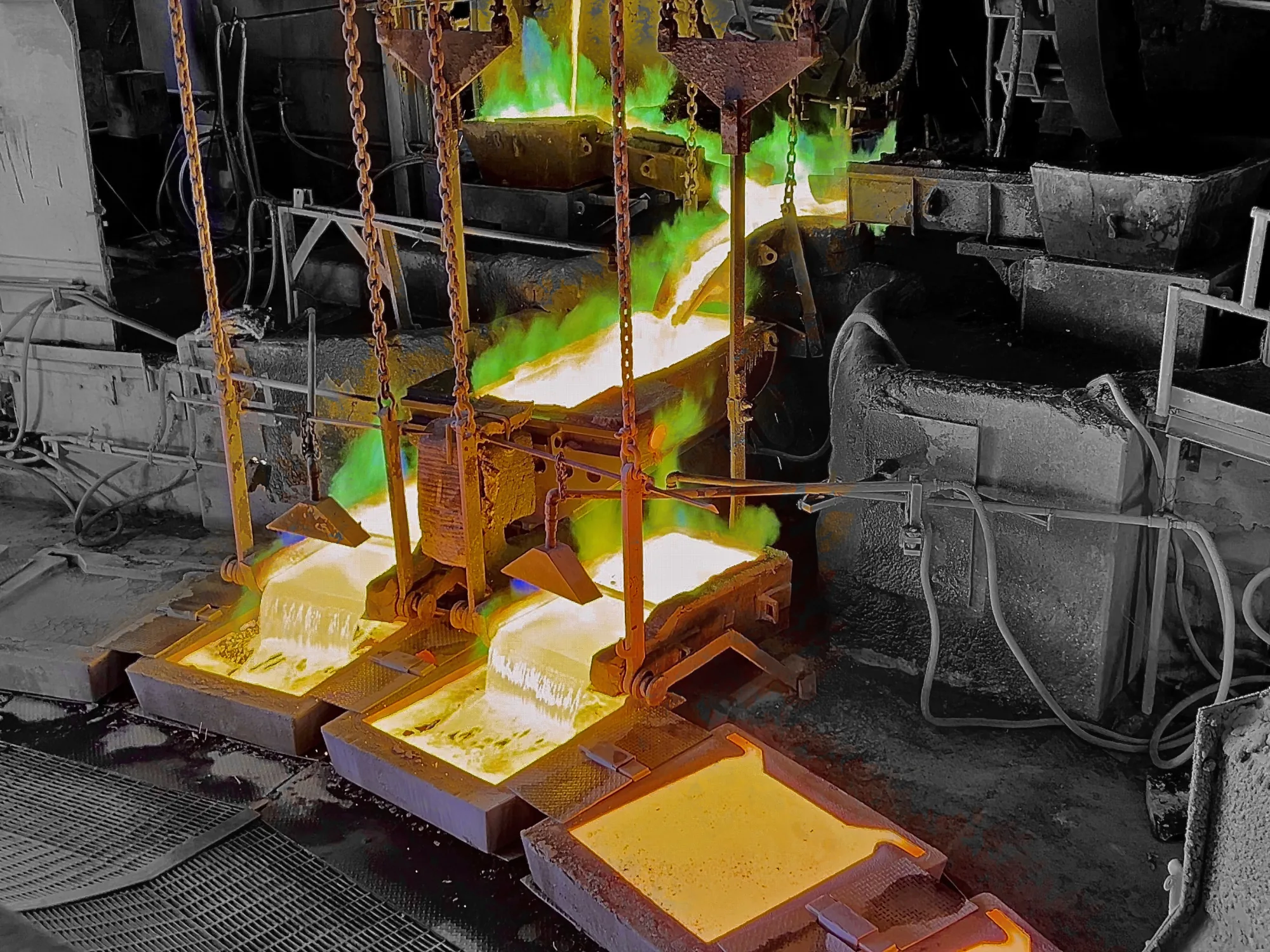
Critical-mineral policy is full of pictures of mines.
Excavators descend through terraced pits. Ore trucks carry rock toward a crusher. The images are legible: resources are in the ground, so security means digging them up.
The hardest dependency often begins after the truck leaves.
Ore must be crushed, concentrated, separated, purified, converted into chemicals or metals, and qualified for a specific customer. A lithium-bearing rock is not a battery input. Rare-earth concentrate is not a magnet. Copper concentrate is not wire. Between geology and a finished component sits an industrial chain of chemistry, heat, water, equipment, waste handling and process knowledge.
That middle is the refinery gap.
A mine produces a feedstock, not a supply chain
Mineral deposits differ. Their valuable elements occur in different minerals, grades and associations. A processing route designed around one ore body may not transfer cleanly to another. Impurities that seem minor in the ground can complicate separation, reduce recovery or make a product unacceptable to downstream customers.
The first stages usually reduce volume. Crushing and grinding liberate valuable minerals from surrounding rock. Physical processes such as flotation or magnetic separation create a concentrate. Chemical steps then separate and purify target elements. Depending on the material, refiners may use high temperatures, acids, solvents, electrolysis, precipitation and repeated extraction cycles.
Each step trades recovery, purity, cost and environmental burden. Recover more of the target and a process may also consume more energy or reagent. Remove one impurity and create a difficult waste stream. Optimize for a headline mineral and lose valuable by-products.
This is why “domestic reserves” and “domestic production” can describe very different capabilities. A country may mine material, export the concentrate for processing and import a qualified product. The rock crossed the border twice because the expertise, equipment and customer relationships live elsewhere.
The U.S. Geological Survey’s annual Mineral Commodity Summaries tracks more than 90 minerals and materials, including domestic industry, trade and global production.1 Read across the individual summaries and a repeated structure appears: geological resources may be broad while processing and usable supply remain concentrated.
Concentration increased while everyone discussed diversification
The energy transition raised demand for lithium, nickel, cobalt, graphite, copper and rare earths. Governments responded with strategies, funding programs and new mine proposals. Yet the most concentrated part of the chain became more concentrated.
The International Energy Agency reports that, excluding rare earths, the average share held by the largest refining country rose to 72 percent in 2025, from 70 percent in 2023. Indonesia led nickel; China led most other key energy minerals. Together, leading producers accounted for more than three-quarters of refined-supply growth over those two years.2
This is not simply a result of inattention. Incumbent refiners possess operating knowledge, integrated supplier networks, trained labor and customers willing to qualify their output. They can expand an existing line more quickly than a new region can permit, finance, build, commission and stabilize one.
Low prices can intensify the advantage. A new project with high capital costs needs a durable price to secure financing. An established producer may continue operating through a weak market, making the new project’s economics worse. The market rewards current efficiency even when governments value future diversity.
Resilience is not automatically produced by commodity competition.
Scale-up is where good chemistry goes to fail
A separation method can work in a beaker and fail as a business.
At laboratory scale, researchers can use carefully prepared feedstocks, expensive reagents and close supervision. A commercial plant receives variable material around the clock. Pumps foul. Solvents degrade. heat transfer changes with vessel size. Recycled process water accumulates impurities. A recovery rate that looked excellent can be overwhelmed by reagent cost, maintenance or waste treatment.
The step between a successful experiment and a bankable plant is pilot and demonstration capacity. Engineers need enough material and operating time to learn how the process behaves under variation. Customers need samples produced by the intended route, not by a handcrafted substitute. Financiers need evidence about throughput, recovery, uptime and operating cost.
In May 2026, the U.S. Department of Energy announced $45.7 million for 19 critical-material projects, including pilot-scale work on magnesium and rare-earth processing.5 The scale is modest relative to commercial plants, but the program targets the stage where process claims become operating evidence.
The missing institution in many supply chains is not another research grant or full-scale factory. It is a place where uncertain processes can become boring enough to finance.
Refineries are knowledge systems
Process plants are often treated as collections of equipment. Their advantage also resides in accumulated operating decisions.
Experienced teams know how a specific ore responds when mineralogy changes, which measurements predict a problem hours ahead and how to recover a circuit without contaminating the next batch. Control limits, maintenance intervals and blending rules encode years of mistakes.
That tacit knowledge makes capacity difficult to copy from a process diagram. It also creates an opening for better instrumentation and software. More frequent mineralogical measurement can let a plant adjust before recovery falls. Digital models can connect mine planning to refinery behavior. Advanced controls can stabilize processes that operators currently manage through conservative margins.
But software cannot erase chemistry. A model trained on one feedstock may fail when impurities shift. Sensors installed in corrosive slurries drift and die. A recommendation has value only if operators can understand its evidence and act within the physical plant’s constraints.
The strongest tools make process knowledge portable without pretending it is universal.
By-products rearrange the map
Many strategically important materials are not mined on their own. They are recovered as by-products of larger metal streams.
Gallium can emerge from processing bauxite. Tellurium can be recovered during copper refining. Indium is associated with zinc. The supply of the smaller material is therefore tied to the economics and process design of a much larger commodity.
This creates unusual markets. Demand for a by-product can rise sharply without causing enough additional production of the host metal to balance it. Recovery may require new circuits at existing smelters, but the total by-product revenue can be too small to justify disruption. Material can remain in residue even when its strategic value is high.
The IEA argues that base-metal smelters are strategic assets because they provide access to many minor minerals.2 A resilience strategy focused on opening named critical-mineral mines can miss the plants where several supply chains actually converge.
Waste streams deserve the same attention. Tailings, slags, coal ash and industrial residues contain materials previous processes were not designed to recover. They are not free ore: grades may be low, chemistry difficult and liabilities substantial. Yet they begin with material already mined and often located near infrastructure.
The refinery of the future may sit beside the refinery of the past.
Qualification is part of production
A processor can meet a chemical purity specification and still fail to sell into a demanding application.
Battery materials must behave consistently across particle size, morphology, moisture and electrochemical performance. Magnet makers care about exact rare-earth composition and downstream alloy behavior. Semiconductor materials demand extraordinary control of impurities. Customers qualify a material and process together because small changes can alter their yield and product reliability.
That process takes time and material. A new refiner needs willing customers before it has steady production; customers want steady production before they redesign around a new refiner. Offtake agreements can bridge the gap, but only when both parties believe the plant will reach specification.
Traceability adds another layer. Companies and governments increasingly want to know origin, processing route and environmental or labor attributes. The IEA’s 2026 survey found that two-thirds of responding companies had some traceability system, though full coverage was far from universal.4
A useful material passport has to survive blending, conversion and by-product recovery. It must be auditable without revealing every commercial secret. As with the material itself, provenance has to be refined.
Recycling joins the middle
Recycling is often presented as an alternative to mining. It is more accurately another feedstock for processing.
End-of-life batteries, motors and electronics must be collected, identified, dismantled and transformed into material clean enough to re-enter manufacturing. Scrap composition varies by product and generation. Some processes recover broad mixtures that require further refining; others target higher-purity streams but demand precise sorting.
The advantage is important: manufactured products can contain higher concentrations than natural ore, and recycling reduces exposure to mine-development timelines. The limitation is temporal. Fast-growing markets do not have enough old products returning to supply all new demand.
Primary and secondary material will share plants, standards and customers. Designs that make disassembly easier, data that reveals product composition, and commercial systems that secure predictable feedstock can improve the economics before a new chemical process is invented.
Price is not the same as availability
Commodity markets summarize supply and demand into a price, but small strategic materials do not always produce deep, transparent markets. Transactions can be bilateral, specifications differ, inventories are unclear and a minor material may represent little cost inside a valuable product.
That asymmetry creates violent consequences. A manufacturer may use only grams of a material in each motor or chip-making tool. Paying twice as much for those grams would barely change the final product’s cost. Losing the material entirely can stop the line.
Long-term purchasing is one response. An offtake agreement gives a new processor revenue visibility and gives a customer claim on future output. Price floors or contracts for difference can protect projects when incumbent supply pushes prices below the level required for diversification. Strategic inventories can buy time during a disruption.
Each instrument can also preserve weak projects. A plant that cannot reach competitive recovery, quality or uptime does not become resilient because a government guarantees its output. Support should be tied to operating milestones, customer qualification and credible paths down the cost curve.
Substitution is another form of supply. Engineers can reduce the amount of a constrained material, recover it from manufacturing scrap or redesign a component around a more available input. Those changes take qualification time and may sacrifice performance, which is why they need to begin before a shortage.
A mature mineral strategy manages a portfolio: diversified primary production, processing, recycling, inventories, offtake and substitution. It does not ask one mine to solve a chain.
The correct metric is not the domestic tonnage announced. It is how many independent, qualified routes can deliver the material a factory actually consumes—and how quickly the system can adapt when one route disappears.
Where the industrial opportunities sit
The refinery gap contains several categories of builder:
- modular pilot equipment that shortens the path from chemistry to continuous operation;
- sensors that survive harsh process environments;
- ore and feedstock characterization tied to real-time control;
- simulation and digital twins grounded in mass balance;
- systems for tracking material through blending and transformation;
- marketplaces and financing for by-product recovery;
- qualification infrastructure shared by emerging suppliers and customers;
- recovery from tailings, industrial residues and end-of-life products;
- reagent regeneration, water reuse and waste reduction;
- flexible plants able to process variable feeds without losing product consistency.
The hard part is integration. A better separation is only valuable when its reagents, waste, energy, maintenance, permitting and product qualification work together.
Security is measured in conversion
Export controls in 2025 turned concentrated mineral supply from a scenario into an operating constraint. The IEA estimates that one country was the dominant refiner for 19 of 20 energy-related strategic minerals in 2024, with an average share near 70 percent.7
The response cannot be autarky across every material and stage. It can be enough qualified alternatives, shared reserves, substitution options and processing knowledge that no single interruption stops a downstream industry.
That resilience will often look unglamorous: a solvent circuit, a pilot kiln, a customer qualification line, a recovery process added to an old smelter. These are the facilities that convert geological possibility into industrial choice.
A mine proves a resource exists. A refinery proves a society can use it.