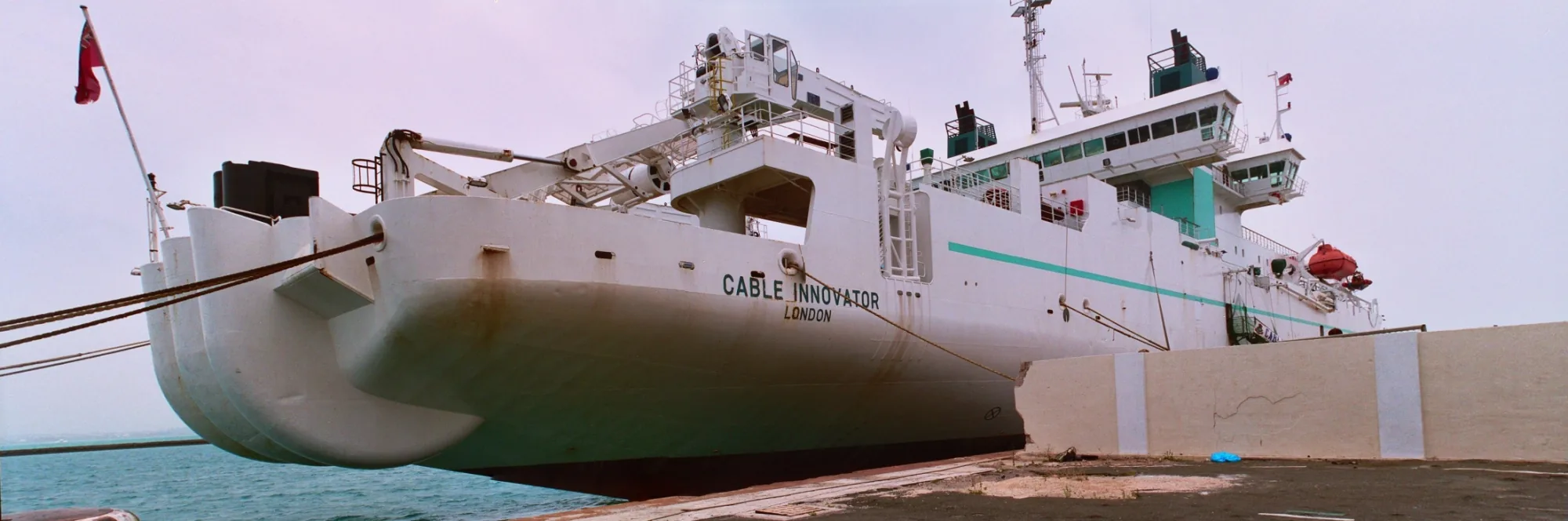
The internet looks weightless from a screen. A message leaves a phone, enters a cloud and appears on another continent. The interface hides distance so well that the network’s physical reality feels almost impolite to mention.
Across oceans, that reality is a cable roughly the width of a garden hose.
At its center sit hair-thin strands of glass. Around them are layers of protection against water pressure, abrasion, anchors and fishing gear. Optical repeaters placed along the route amplify the signal. Near shore, where human activity is most dangerous, the cable may be armored and buried. In deep water it can rest on the seabed for thousands of kilometers.
More than 99 percent of international data traffic travels through submarine telecommunications cables, according to the International Telecommunication Union.2 Finance, cloud computing, government communications and ordinary conversation share this submerged system.
The internet is not in the sky. It is under the sea, and it is repaired by ships.
Thin lines, enormous systems
A modern cable is not simply a passive strand between two countries. It is a system of landing stations, terrestrial backhaul, power-feed equipment, repeaters, branching units, marine surveys, route permits and operational agreements.
Data enters at a landing station, is converted into optical signals and sent through fiber pairs. Electricity supplied from shore powers repeaters along the route. At the other end, another landing station hands traffic back to terrestrial networks. Capacity owners may include telecom operators, infrastructure consortia and large cloud companies; a single system can connect several jurisdictions through branching paths.
The physical cable is small because fiber is extraordinarily capable. The infrastructure around it is large because reliability is an institutional product.
Hundreds of commercial cables now span more than 1.7 million kilometers.4 That apparent abundance is uneven. Some countries connect through many independent systems and landing zones. Others depend on a small number of routes that approach shore through the same corridor. A map with several colored lines can conceal a shared trench, shared station or shared terrestrial link.
Resilience depends on diversity that survives inspection.
Most failures are ordinary
Submarine cables attract stories about espionage and sabotage because the stakes are high and the ocean is opaque. Intentional damage is a real planning concern. Most disruptions, however, begin with routine maritime activity.
Fishing equipment and anchors are leading causes of cable damage, followed by natural hazards such as earthquakes, underwater landslides and tsunamis. More than 170 repairs were reported worldwide in 2025—almost four each week.3
This frequency changes the meaning of resilience. The network is not protected by preventing every break. It survives because traffic can be rerouted and broken systems can be found, recovered and spliced.
When a link fails, operators use electrical and optical measurements to estimate where the fault occurred. A repair ship sails to the location, retrieves the cable from the seabed, cuts away the damaged section, splices in replacement cable, tests the repair and lowers it back. In deep water, the operation can involve grapnels dragged across a predicted position. Near shore, remotely operated vehicles and burial equipment may be needed.
The work is a mixture of precision telecommunications and heavy marine operations. Weather determines when it can happen.
The scarce resource is readiness
A country can buy additional network capacity in software. It cannot instantly create a cable repair ship, trained crew or permit to enter contested waters.
The global repair fleet is limited and organized through regional maintenance agreements and commercial contracts. A ship may need days to reach a fault. Port access, customs, crew visas, protected areas and authorization to work in territorial waters can add delay before the sea state is even considered.
The ITU’s 2026 working-group report treats timely deployment and repair as a regulatory problem as much as a technical one.1 Its recommendations include predictable permitting, stronger maintenance coverage, shared best practices and cooperation between governments and operators.
This is a recurring pattern in frontier infrastructure: the emergency reveals that paperwork was part of the machine all along.
Preparedness means pre-negotiated procedures, current contact points, spare cable and repeaters positioned within reach, vessels under effective agreements, and exercises that test the full chain. It also means knowing which ministries have authority when communications, maritime safety, national security and environmental rules overlap.
Landing stations concentrate the ocean
The longest portion of a cable may lie beyond territorial waters, but its narrowest vulnerabilities are often on land.
Landing stations gather fibers, power equipment and network connections into physical sites. Several cables may arrive in the same coastal area because it offers gentle seabed terrain, existing backhaul and efficient permitting. Those economics create concentration.
A robust national cable strategy must look beyond the number of systems. Do routes approach from different directions? Do they land in separate hazard zones? Does terrestrial backhaul follow separate corridors? Are stations supplied by independent power and communications? Can traffic move to another country if domestic landing capacity is impaired?
Geographic diversity is expensive because it deliberately rejects some economies of scale. A second route may serve less traffic in normal conditions. A remote landing station needs terrestrial infrastructure. Redundant repair capability may sit idle.
That slack is the product. A network optimized only for utilization will look efficient immediately before it fails.
Small island states face the sharpest version of the problem. They may have too little traffic to finance several independent systems but suffer disproportionate consequences when one fails. The ITU’s final 2026 report highlights dependence on a small number of cables as a particular risk for islands, least-developed countries and underserved regions.2
Resilience funding therefore has characteristics of both development finance and insurance.
Visibility has limits
Operators know the condition of their own systems. Governments need enough shared information to assess national and regional risk. Publishing exact operational details can create security concerns, while keeping everything proprietary prevents coordinated planning.
The 2026 ITU recommendations call for stronger incident reporting, risk monitoring, legal frameworks, nautical charting, stress tests and information sharing.1 The difficult design question is granularity: what needs to be common, what should remain restricted and who is trusted to hold the combined view.
Good visibility has at least three layers.
The operational layer helps an owner locate and repair a fault. The coordination layer lets authorities manage ships, permits and cross-border impacts. The strategic layer reveals concentration and underinvestment without exposing details that would make interference easier.
No map solves this by itself. A cable route is not static truth. It has burial depth, age, repair history, ownership, available fiber pairs, landing dependencies and shifting hazards. The useful representation is a maintained system model.
Security changes the investment case
Europe has moved cable resilience from general concern into funded policy. In February 2026, the European Commission announced a cable-security toolbox and €347 million for strategic projects, including a €20 million call focused on adaptable repair modules.5
Modular repair equipment is revealing. Building additional specialized ships is slow and expensive. Containerized or adaptable systems can expand the set of vessels able to support parts of a repair operation. The concept does not eliminate the need for expert cable ships, but it may create surge capacity and improve coverage in underserved regions.
Security policy also changes which projects can be financed. A route that appears marginal on traffic revenue may be valuable because it bypasses a chokepoint. Governments can support that public value through guarantees, blended finance, anchor tenancy or direct investment.
The risk is funding symbolic lines without the operational ecosystem to maintain them. A resilient cable needs landing access, backhaul, spares, crews, monitoring and repair agreements for its entire life.
Capacity ownership is changing
Submarine cables were traditionally built by groups of telecommunications carriers that divided capacity and cost. Large cloud platforms now finance and participate in systems because their own traffic justifies infrastructure at ocean scale.
That shift can increase investment and align routes with rapidly growing data-center regions. It can also change the topology of dependence. A company that owns cloud facilities, terrestrial backbone and undersea capacity can optimize the path end to end. Smaller networks may gain abundant wholesale capacity while becoming more dependent on infrastructure designed around another firm’s geography.
Resilience analysis has to distinguish physical diversity from commercial diversity. Two services purchased from different brands may use the same cable or landing station. Conversely, capacity controlled by one large owner may travel over genuinely independent paths. Procurement needs evidence about shared-risk groups, not only supplier names.
New cable economics also affect underserved regions. A branch can connect a market along a route built primarily between larger hubs, but the branch may remain a single point of failure. A landing can create local opportunity only if neutral backhaul, data centers and exchange points allow domestic networks to use it competitively.
The cable is therefore a platform for an ecosystem on shore. Countries that pair new systems with open landing access, redundant terrestrial paths and local interconnection can turn transit into durable digital capacity. Those that treat the landing ceremony as completion may discover that most of the economic value continues through them.
Ownership is not itself the risk. Opacity is. Operators, customers and governments need enough structural information to understand which failures connect apparently separate services.
Where builders can enter
The largest projects belong to infrastructure consortia, ship operators and states. Smaller companies can still improve the system at its interfaces:
- risk models that combine routes, seabed hazards, vessel traffic and terrestrial dependencies;
- permitting systems that preserve security while reducing repair delay;
- shared incident reporting with tiered access;
- cable-health sensing and anomaly detection;
- simulation tools for route diversity and traffic failover;
- inventory and logistics systems for spare cable, repeaters and repair equipment;
- modular marine tooling and autonomous inspection;
- financing products tied to measurable resilience;
- secure coordination rooms for owners, governments and repair operators.
The valuable software is attached to an operational decision. It helps someone route, permit, inspect, dispatch, repair or invest faster.
The cloud has a coastline
The submarine network is an argument against treating digital and physical infrastructure as separate worlds. Every cloud region depends on electricity, land, cooling and terrestrial fiber. Every international connection eventually passes through a beach, a building and a jurisdiction.
The network works so reliably that its physical form disappears from ordinary life. That is a triumph of engineering and maintenance, not evidence that matter no longer matters.
The next era of internet resilience will be built by making hidden dependencies visible without making them vulnerable; by financing routes that earn their value during failure; and by treating repair time as a design variable rather than an unfortunate aftermath.
The internet crosses an ocean at the speed of light. Restoring the glass can still take a ship.