Space companies are introduced by what they put above Earth.
Rockets rise. Satellites unfold solar arrays. Images arrive from orbit. A mission’s most compelling artifacts are separated from the ground because leaving the ground is what makes them remarkable.
Operationally, space never leaves it.
A spacecraft needs a licensed frequency, a station to hear it, a network to move its data, a control room to command it, software to schedule contact and people to respond when its state stops matching the plan. A launcher needs a range, weather data, airspace coordination, propellant systems, roads and emergency services. An Earth-observation business needs terrestrial compute and a delivery path to the customer.
The ground segment is where an object in space becomes a service.
A satellite is unavailable most of the time
A spacecraft in low Earth orbit circles quickly and passes over any given antenna for minutes. Earth blocks the signal for the rest of the orbit. To receive data frequently, an operator needs stations at several longitudes or access to a relay network.
This creates a scheduling problem before it creates a radio problem. Missions request contact windows. Antennas must support the right frequency, polarization, data rate and pointing accuracy. Higher-priority passes displace lower-priority ones. Weather can impair optical links and some high-frequency radio. Maintenance removes capacity.
NASA’s Near Space Network combines more than 40 government and commercial antennas with space-based relay satellites, supporting missions out to 1.25 million miles from Earth.3 Its architecture shows how much infrastructure is required to make continuous connectivity feel like a feature of the spacecraft.
Commercial ground-station networks have turned parts of this capacity into a service. A small satellite team can buy passes instead of constructing sites around the world. Cloud integration can send received data directly into processing pipelines. Standard interfaces can reduce the mission-specific racks once installed at every station.
The abstraction is valuable. Beneath it remain antennas, spectrum rights, local fiber, weather, technicians and land.
Distance makes the link visible
Deep-space communication removes any illusion that connectivity is automatic.
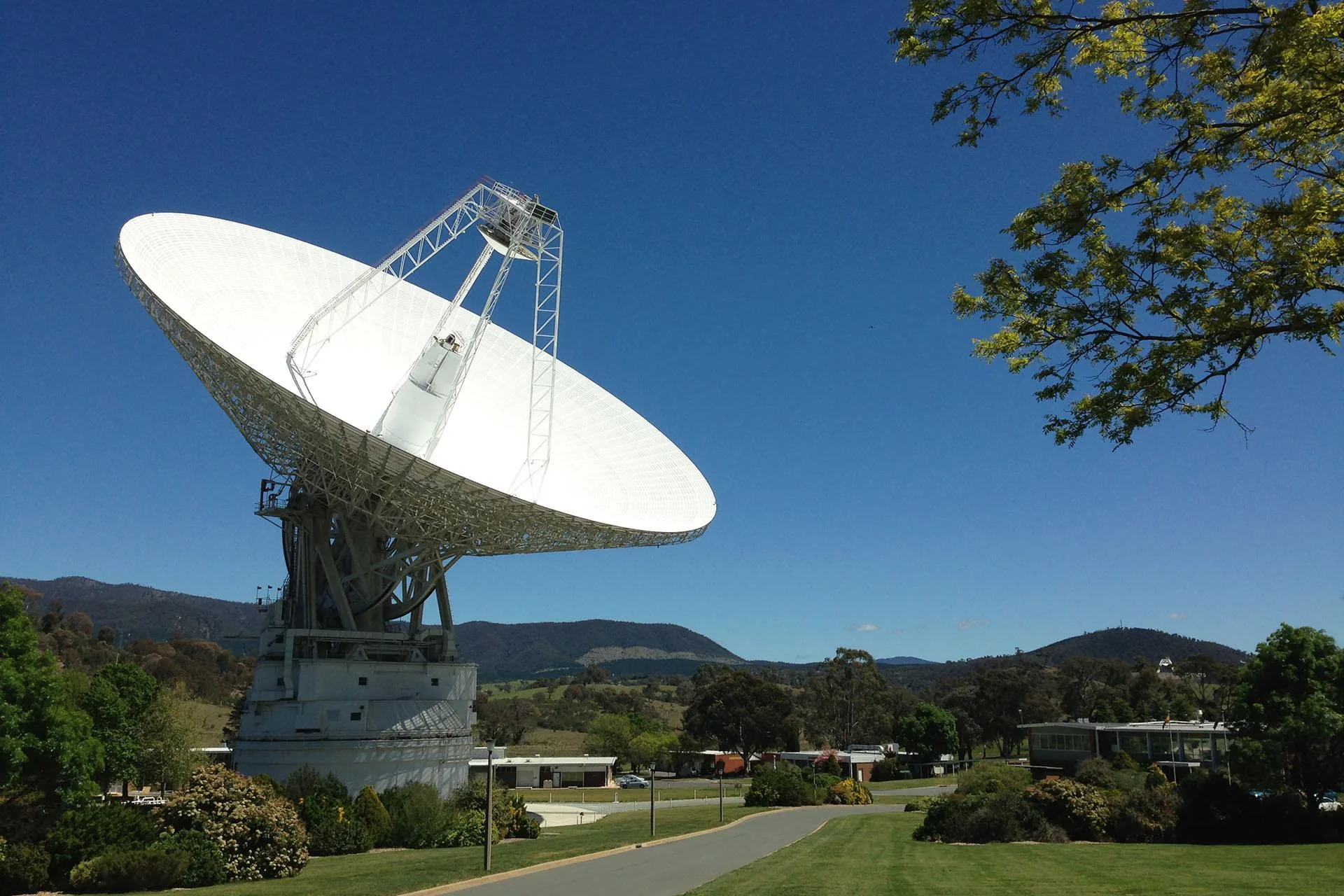
NASA’s Deep Space Network uses three complexes near Goldstone, Madrid and Canberra, spaced roughly 120 degrees apart so Earth’s rotation can hand a distant spacecraft from one site to another.2 Each site contains multiple large antennas, including 70-meter dishes sensitive enough to recover faint signals from missions across the solar system.
The geometry is planetary. Canberra is uniquely positioned to communicate with Voyager 2 as it travels south of the plane containing most planets. A new 34-meter antenna under construction there is intended to increase capacity as missions return more data.7
Data rate falls as distance and signal loss grow. Spacecraft power and antenna size are constrained. Ground systems compensate with larger apertures, colder and more sensitive receivers, precise pointing, coding and long integration times. Several antennas can be arrayed to behave like a larger one.
Every improvement changes mission design. A better ground receiver can reduce what a spacecraft must carry. More available contact time can support additional instruments. A congested network can force a mission to collect less than its hardware could produce.
The scientific return of a spacecraft is partly a property of Earth.
Commercialization begins with capacity
NASA plans to rely more heavily on commercial communication services for near-Earth missions while preserving government networks for capabilities the market does not yet provide. In 2024 it selected four companies under contracts with a cumulative maximum value of $4.82 billion to expand direct-to-Earth services through 2034.4
The transition matters beyond procurement. Government demand can anchor stations in locations where early commercial traffic would not justify them. Providers can then sell the same network to multiple missions. Shared infrastructure lowers the cost of entering orbit.
But aggregation creates dependencies. A ground-station provider may rely on third-party antennas, cloud regions, terrestrial carriers and local operators. Mission teams need to know how service degrades when one link fails. A map of global coverage is not enough; they need availability by frequency, elevation, time, weather and end-to-end delivery.
The 2026 edition of NASA’s small-spacecraft technology survey notes that commercial providers still do not support missions at Sun-Earth Lagrange points or in deep space, leaving the Deep Space Network and larger Near Space Network assets essential.1
Commercialization is not a handoff from public to private. It is an evolving boundary between shared public capability and markets deep enough to sustain alternatives.
The range is a factory floor
Launch has its own ground bottlenecks.
A range tracks vehicles, protects the public, coordinates restricted airspace and provides telemetry and flight-safety systems. Pads need refurbishment. Roads carry oversized hardware. Processing buildings integrate payloads and launch vehicles. Propellant and power systems must be available at the right moment.
As launch cadence increases, these shared assets become production equipment. A delay on one pad can affect several missions. An airspace closure creates cost for airlines and communities. Range instrumentation designed for a smaller era must support more simultaneous and varied operations.
Commercial launches from U.S. federal ranges more than quadrupled from 2021 through 2024, according to the Government Accountability Office. The Department of Defense expected to spend more than $18 billion on launch services and infrastructure over the following five years, while its system for recovering infrastructure costs from commercial users remained incomplete.5
That accounting issue is architectural. If prices do not reflect the capacity a launch consumes, ranges struggle to signal where investment is needed. If charges are unpredictable, companies cannot plan. A high-cadence space economy needs transparent rules for paying for the factory floor.
The FAA’s role connects launch operations to the national airspace system. Launch and reentry licenses require coordination with air-traffic facilities, and site development can intersect with existing airports and communities. The future cadence described in FAA forecasts is therefore constrained by integration, not only vehicle availability.6
Mission control is product operations
After launch, the center of gravity moves to a room of screens and software.
Operators estimate the spacecraft’s orbit, monitor power and thermal state, schedule payload activity, prepare commands and respond to anomalies. Automated systems handle routine contacts, but abnormal conditions concentrate judgment. A single mistaken command can end a mission with no physical repair possible.
This makes mission operations an extreme version of a general software problem: remote systems, intermittent connectivity, delayed feedback and irreversible actions.
The best architectures separate intent from execution. Commands are validated against spacecraft state and operational constraints. Procedures are versioned. Simulators test sequences before uplink. Telemetry preserves provenance from antenna through processing. Authority is explicit, particularly when several organizations share a mission.
Small satellites once tolerated improvised operations because missions were short and inexpensive. As constellations grow, artisanal control rooms stop scaling. Operators need fleet-level scheduling, anomaly triage and software deployment while preserving the ability to reason about one unusual spacecraft.
Autonomy on orbit does not eliminate ground operations. It changes their unit of attention from every action to exceptions and policy.
Optical links move the bottleneck
Laser communications promise much higher data rates than conventional radio for a given size and power. NASA’s Deep Space Optical Communications demonstration showed that optical links can return high-rate data across interplanetary distances. The ground requirements are different.
A laser beam is narrow. Pointing must be precise. Clouds block it. Daylight and atmospheric turbulence complicate reception. A reliable optical network needs multiple geographically separated ground stations, forecasts and the ability to shift contact.
The technology moves capacity from scarce spectrum toward scarce clear sky.
Hybrid networks are likely. Radio provides robust command and lower-rate connectivity; optical terminals carry large data volumes when conditions allow. Scheduling software chooses among them based on urgency, weather, geometry and price.
This is a reminder that new communications technology rarely removes infrastructure. It changes which infrastructure matters.
Earth observation ends in a decision
For commercial missions, receiving bits is not the final ground segment. Data has to become useful before it becomes stale.
An imaging satellite may downlink raw scenes into a station, move them through terrestrial fiber to cloud compute, calibrate and geolocate them, run models, and deliver an alert to a farmer, insurer, ship operator or emergency service. Latency across that chain can matter more than the spacecraft’s nominal resolution.
The business is therefore an integrated system: orbital asset, contact capacity, processing, model, distribution and customer workflow. A company with excellent hardware can fail because it cannot reliably deliver an answer. A company with ordinary sensors can create value by closing the loop quickly.
The opportunities on the ground include:
- scheduling across independent antenna networks;
- end-to-end observability from spacecraft to customer;
- resilient mission-control software and high-fidelity simulators;
- automated spectrum coordination and interference detection;
- optical-ground-site forecasting and network selection;
- shared range infrastructure and cadence-aware logistics;
- cloud pipelines that preserve scientific calibration and provenance;
- cybersecurity designed for intermittent remote assets;
- insurance and financing based on operational evidence rather than mission class alone.
These are not secondary services around a spacecraft. They determine how much of its designed capability can be used.
Ground infrastructure creates geography
The space economy is global, but ground sites are not interchangeable.
An antenna benefits from a clear horizon, low radio interference, reliable power and terrestrial connectivity. Polar-orbiting satellites create strong demand for high-latitude stations because they pass near the poles on each orbit. Optical stations need favorable cloud patterns. Launch sites need safe downrange corridors. Deep-space antennas need geometric separation across the rotating Earth.
These constraints create strategic locations. A remote site can participate in many missions if it connects physical advantage to dependable operations. It needs roads, technicians, security, spare parts and enough network bandwidth to move data away. A beautiful radio horizon without local maintenance is fragile capacity.
Communities and governments can capture more value by building clusters around the ground asset: integration facilities, mission-operations teams, data processing, training and suppliers. The alternative is an isolated antenna that exports raw data and imports every expert.
Concentration deserves attention too. Several providers may colocate because one region has excellent geometry and infrastructure. That improves economics but exposes them to the same weather, grid failure, fiber cut or political event. Mission planners should treat geographic correlation with the same seriousness as spacecraft redundancy.
Climate changes some of these assumptions. Fire, flood, heat, storms and water availability affect sites designed for decades of service. A ground network can route around local weather only if alternatives use different hazard zones and have compatible equipment.
Site selection is thus part radio science, part network architecture and part regional development. The strongest locations are not merely places where a signal can land. They are places capable of keeping the service alive and converting it into knowledge, jobs and further infrastructure.
The frontier has foundations
Space invites vertical thinking: climb higher, travel farther, build above. Its industrial system grows horizontally across Earth.
An antenna in Antarctica, a range in Florida, a licensing office, an undersea cable and a cloud region can all participate in one mission. The spacecraft is the most distant component, not the entire product.
This perspective changes what a credible space company looks like. It understands contact minutes, range constraints, operations labor, terrestrial delivery and regulatory time. It designs the flight segment and ground segment as one system. It knows where shared infrastructure creates leverage and where dependence creates unacceptable risk.
Orbit begins at the pad. Value ends with someone on Earth able to use what came back.