The standard image of scientific discovery is a person at a bench.
The scientist forms a hypothesis, prepares a sample, operates an instrument, studies the result and decides what to try next. Modern laboratories distribute that sequence across teams and software, but the basic loop remains recognizable. Its rate is limited by human attention, instrument availability, handoffs and the time required to turn an observation into another experiment.
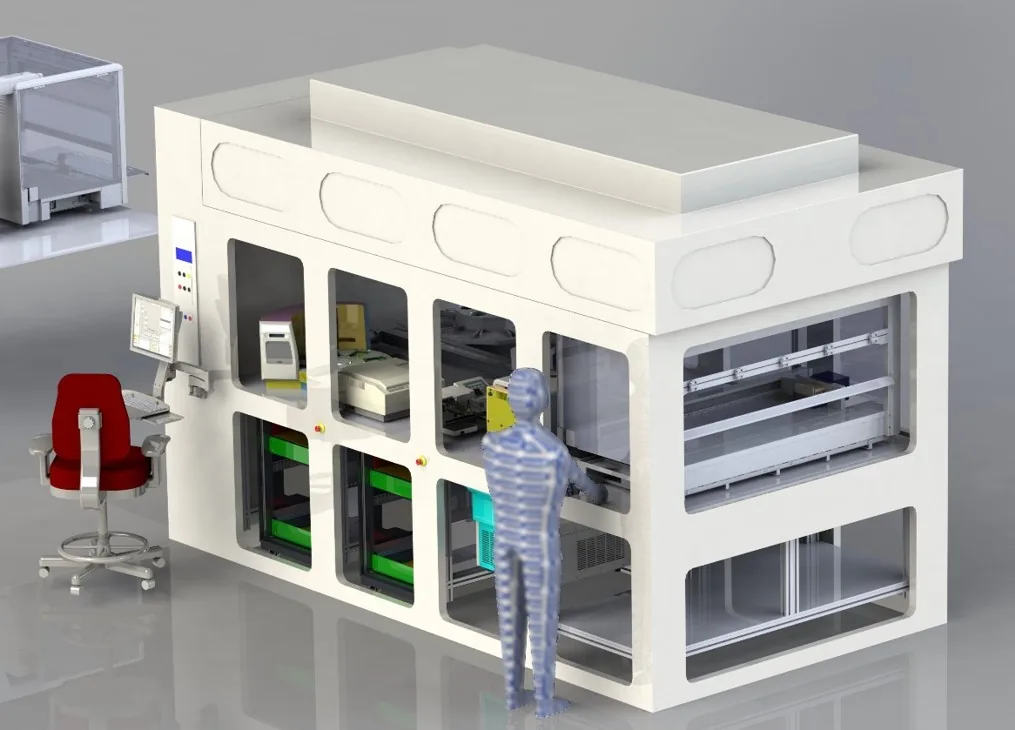
A self-driving laboratory changes the loop.
Robots handle materials. Instruments return structured measurements. An algorithm chooses the next experiment based on what previous experiments taught it. The system does not merely execute a fixed plate of samples faster. It can alter the campaign while it is running.
That distinction—automation versus autonomy—is the beginning of a new industrial model for discovery.
The experiment after this one
Traditional high-throughput science asks many questions in parallel. It is powerful when researchers know the space they want to search, but exhaustive grids scale badly. Ten possible values across five independent variables already create 100,000 combinations.
An autonomous system instead chooses the next measurement for its information value. It can explore uncertain regions, exploit a promising result, revise a failed recipe or stop when additional work is unlikely to matter. The goal is not to maximize the number of experiments. It is to maximize learning per unit of time, material and instrument capacity.
NIST describes the model as a closed feedback loop joining algorithms, sample generation, handling and characterization.1 Human researchers set objectives, constraints and available methods. The laboratory navigates within them.
The A-Lab at Lawrence Berkeley National Laboratory made the idea concrete. Over 17 days of continuous operation, its system performed 353 experiments and synthesized 36 of 57 targeted inorganic compounds.2 It combined predicted materials, synthesis knowledge extracted from literature, robotic handling, machine interpretation of X-ray diffraction and active learning from failed recipes.
The important output was not only 36 materials. It was a record of how computation, literature and physical evidence could remain connected through hundreds of decisions.
Failure is part of the control system
A conventional automation demo is expected to run cleanly. Science is valuable precisely where outcomes are uncertain.
The A-Lab did not reach every target. Some reactions were slowed by kinetics the decision system did not model well. Some computational predictions did not translate into synthesizable compounds. These were not merely errors around the result; they exposed where the laboratory’s representation of chemistry was incomplete.
That is what makes a closed loop more than a robotic arm. A failed synthesis can update the choice of precursor, temperature or dwell time. A disputed measurement can trigger confirmation. The machine’s behavior changes in response to the world.
Yet this also makes evaluation difficult. Two laboratories may both call themselves autonomous while one optimizes a single variable for an afternoon and another coordinates synthesis, measurement and interpretation for weeks. Researchers have proposed metrics spanning degree of autonomy, operating lifetime, throughput, precision, material use, accessible parameter space and optimization efficiency.3
No single speedup captures scientific value. A system that runs quickly but explores a trivial space may matter less than one that rejects an incorrect assumption.
The laboratory needs an operating system
Today’s autonomous labs are largely bespoke. A liquid handler speaks one interface, a spectrometer another, and a furnace may not expose a modern programming surface at all. Samples need identifiers that survive transfers. Units, calibration state and uncertainty must travel with measurements. Safety systems need authority to interrupt the plan.
NIST identifies four missing layers for a modular ecosystem: sample management, instrument communication and control, data and knowledge management, and algorithm integration.4
These are the beginnings of a laboratory operating system.
The analogy should not be taken too literally. An experiment can consume irreplaceable material, produce hazardous conditions or contaminate an instrument. Physical state is not as easily reset as a software process. But the operating-system functions are recognizable: schedule resources, mediate permissions, represent state, recover from faults and provide stable interfaces above changing hardware.
Argonne’s Polybot demonstrates the modular direction. It combines liquid and powder handling, mobile robots, coating and heating systems, characterization instruments, databases and active-learning software.6 The mobile robot is particularly instructive. Rather than rebuilding every instrument into one monolithic line, it can move samples among existing stations.
The more flexible the laboratory becomes, the more important its shared representation of the experiment becomes.
Knowledge has to move with the sample
Scientific data is often stored as files organized around instruments and projects. An autonomous laboratory needs a live account of relationships: which sample came from which batch, which procedure changed it, which calibration governed the reading, which model proposed the step and which objective made the result relevant.
Knowledge graphs are one way to represent that structure. In a distributed self-driving laboratory demonstration, researchers used an evolving graph to coordinate two robotic systems and optimize cost and yield across organizations.5 The graph was not an archive added after the work. It was part of the executable system.
This is where autonomous science intersects with reproducibility. A published recipe is often less complete than it appears because crucial technique remains tacit: the way a powder was mixed, the state of an instrument, an exception a researcher noticed. Automation forces those decisions into explicit interfaces and logs.
It can create far better provenance. It can also create reproducible confusion if metadata is wrong, instruments drift or an algorithm optimizes a proxy no scientist intended. Structured data is not inherently truthful. It is simply easier to inspect.
The human role moves upward and sideways
The easy story is that robots replace laboratory technicians and AI replaces scientists. The actual redistribution is more interesting.
Humans still decide which problems deserve scarce experimental time. They define objectives that capture scientific value rather than convenience. They design the accessible parameter space, establish safety limits, maintain instruments, investigate anomalies and connect results to theories the system does not possess.
Autonomy also creates new forms of craft. A scientist has to understand how uncertainty moves from an instrument into a model’s next choice. A roboticist has to understand which handling error changes the chemistry. A software engineer has to know when a retry would quietly invalidate the experimental record.
The highest-value work gathers at the boundaries between disciplines.
There is a workforce risk here. Repetitive bench work is also how researchers develop physical intuition. A person learns what a suspicious precipitate looks like, how a pump sounds before failure and which “clean” signal usually reflects contamination. If automation removes the apprenticeship without capturing its lessons, the laboratory can become more productive and more brittle at once.
Good systems should preserve routes for humans to learn from edge cases, not only approve dashboards.
Biology makes the stakes clearer
Materials laboratories work with complex physical systems. Biology adds replication, mutation and context dependence. The same engineered cell can behave differently across temperature, medium and growth state. Measurement protocols must distinguish a design failure from environmental noise.
NIST’s Living Measurement Systems Foundry automates common engineering-biology workflows including liquid handling, incubation, plate measurement, transformation and centrifugation.8 Its purpose is not simply higher throughput. It is reliable measurement for design-build-test-learn cycles.
That emphasis matters. A laboratory capable of generating more biological variants without stronger measurement can manufacture ambiguity faster. The constraint moves from making samples to knowing what their behavior means.
In drug development, enzyme design and cell engineering, autonomous systems will be judged not by how futuristic the robot appears but by whether they produce results that transfer: from one instrument to another, one laboratory to another, and eventually from an experimental setting into manufacturing or medicine.
A network of laboratories
Once instruments have programmatic interfaces and experiments have portable representations, a campaign does not have to remain inside one building.
One facility may specialize in synthesis, another in microscopy, and a third in a high-energy X-ray source. A planning layer can send samples and tasks across them. Underused equipment becomes addressable capacity. Small teams gain access to workflows that previously required owning an entire stack.
The coordination problem is severe. Schedules, shipping, chain of custody, calibration, identity and data policy cross institutional boundaries. So do failures. A result produced by three facilities needs evidence strong enough to determine which step deserves investigation.
This creates opportunities for builders beyond laboratory robotics:
- instrument adapters and common control layers;
- sample identity and chain-of-custody systems;
- experiment languages that compile intent into safe procedures;
- scheduling markets for distributed scientific equipment;
- uncertainty-aware optimization and stopping rules;
- observability and replay for physical experiments;
- simulators for testing campaigns before consuming materials;
- datasets built from negative results, maintenance events and anomalies;
- interfaces that direct human review toward scientifically consequential disagreements.
The durable platforms will not treat the lab as a collection of devices. They will treat it as a learning system with physical consequences.
Safety cannot be a prompt
An autonomous laboratory acts on matter. That places safety below the level of model judgment.
A planning model may propose a temperature, reagent or sequence that appears useful from literature and conflicts with the actual vessel, ventilation, inventory or waste system. The safeguard cannot be an instruction asking it to be careful. Equipment limits, incompatible materials, authorization boundaries and emergency states need machine-readable enforcement outside the planner.
This suggests a layered control architecture. The scientific agent proposes an experiment. A deterministic policy layer checks materials, quantities, equipment state and approved operating envelopes. Instrument controllers enforce their own interlocks. Independent sensors can halt motion, pressure or heat. Humans approve operations whose uncertainty or consequence exceeds a defined boundary.
Those layers create evidence. A rejected proposal reveals where the planner lacks practical knowledge. A frequently triggered limit may expose a poor workflow or an overly conservative rule. Near misses become structured training material without allowing the learning system to weaken the protection that generated them.
Cybersecurity belongs in the same design. Networked instruments are computers attached to pumps, heaters and biological material. Remote access and shared scheduling increase the number of parties capable of changing physical state. Identity, signed methods, scoped permissions and immutable run records should be native laboratory functions, not enterprise software added around them.
The strongest autonomy is bounded autonomy. A lab earns permission to run longer campaigns as its methods, monitoring and recovery prove reliable. New reagents, instruments and operating regions return it to narrower authority until evidence accumulates.
This is not friction opposed to discovery. It is what allows discovery to continue overnight, across sites and around materials that would otherwise require constant supervision.
Discovery becomes infrastructure
The original industrial laboratory converted capital and expert labor into knowledge. The autonomous laboratory adds a compounding asset: every well-recorded experiment can improve how the next experiment is selected and executed.
That compounding is not guaranteed. It depends on interoperable data, maintained hardware, meaningful metrics and institutional willingness to share enough failures to learn. Without those, each lab remains an expensive island with a robot inside.
The frontier is a laboratory that can explain what it did, learn from what happened and transfer that learning into another campaign. When those properties become infrastructure rather than one-off demonstrations, discovery begins to scale less like a sequence of heroic projects and more like a production system.
The scientist does not disappear from that system. The scientist becomes its architect, critic and source of purpose.